Blue Spot vs Red Zone Forklift Lights: Purpose and Placement
By DXZ Lighting · Updated
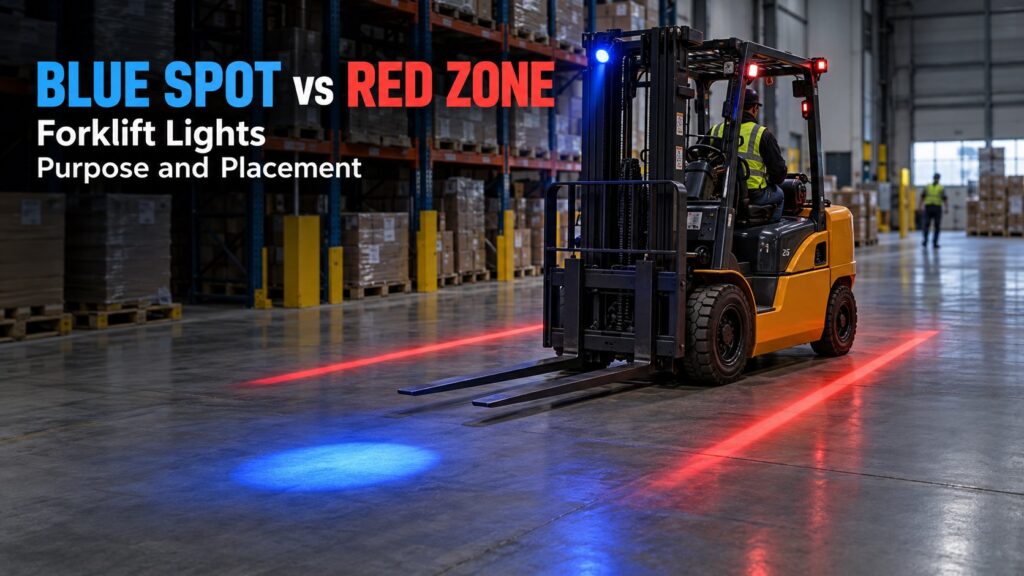
A blue spot forklift light places a localized warning on the floor ahead of or behind the truck. A red zone light usually places a line beside it; a halo model uses a curved pattern. Choose the shape and position for the route and viewing direction, then check whether people can see the cue under the site’s working conditions.
The comparison starts with the warning pattern. Color alone does not establish coverage, visibility or pedestrian clearance. A red spot is also a possible configuration, while white work lighting serves the operator’s task.
What is the difference between a blue spot and a red zone light?
The spot draws attention to a selected floor position on the approach. A line provides a reference beside the truck. An arc provides a curved reference around the intended part of the truck. These are visual cues to assess within the traffic plan.
| Pattern | Intended cue | Placement question | What to check |
|---|---|---|---|
| Blue spot | A localized warning ahead of or behind the truck | Which approach should reveal the cue? | Can people on that approach see the spot in the available light? |
| Red line | A line beside the truck | Where should the line fall relative to the site’s planned clearance? | Is it visible from the relevant pedestrian route? |
| Red halo or arc | A curved floor reference | Which part of the truck and route should the arc mark? | Does the mounted pattern reach the intended floor area? |
| Red spot | A localized floor marker | Does this route call for a marker instead of a line or arc? | Can the observer distinguish it against the floor? |
| White work light | Illumination of the operator’s task | Which surface does the operator need to see? | Does the installed beam reach that surface with the normal load? |
Toyota’s lighting-options guide describes blue spotlights aimed at the ground in front of or behind the truck, with aiming distance selected for the application. It also describes red zone lamps aimed beside the truck and spot options in other colors. Include the shape, mounting and control behavior in the color specification.
When does a blue spot fit the task?
Consider a spot when the warning needs to appear on the approach to an aisle, doorway or crossing. Identify the direction the truck travels and the direction from which a person will observe it. A cue on the floor behind the truck answers a different viewing question from a cue in front.
Ask whether the lamp is continuously active, linked to travel direction or controlled another way. Put that behavior in the specification so the trial represents the configuration that will be supplied.
During the trial, observe from the designated pedestrian route. Record where the spot first becomes visible and whether racks, parked equipment or the carried load obscure it. Use the actual floor and background light. Those observations decide the useful placement for that site.
When does a red line or halo fit the task?
Consider a line when the plan calls for a visible cue beside the truck. Consider an arc when a curved floor reference fits the intended part of the route. State the required shape in the inquiry: a straight line, localized spot and curved halo are different projections.
Set the intended position with the site’s pedestrian-clearance assessment. Then review whether the available mount and aiming range can put the pattern there. Include turning movements in the trial, observing from safe positions under the site procedure.
A halo product name does not by itself establish a complete ring around the truck. Ask for the offered model’s projected shape and the arrangement needed for the planned cue. The physical separation and traffic measures continue to define how people use the route.
How do you check projection position and visibility?
Run a controlled sample check before repeating the installation across a fleet. Record the model, control mode and mount so the result can be reproduced.
- Identify the pedestrian observation point and the intended warning location.
- Trial the available mounting position and aiming adjustment on the truck.
- Observe with the load and mast in the operating positions used on the route.
- Repeat under the facility lighting and daylight conditions relevant to the job.
- Record the floor condition and any location where the cue becomes obscured or difficult to distinguish.
If the cue cannot be seen from the required approach, review its position and pattern with the traffic layout. Where the problem is a dark fork, pallet opening or travel surface, use the work-area selection guide to assess white task lighting. The warehouse lighting checklist provides a record for the fitted arrangement.
Is blue or red safer?
The evidence used here does not rank the two colors by collision prevention. A 2020 pilot study archived by CDC fitted blue and red lights to three forklifts for four months in a warehouse. Nine employees, including operators and pedestrians, gave feedback; all reported greater forklift visibility and conspicuity. The study’s employee feedback supports evaluating visual warnings, but does not establish an accident-reduction percentage or a color ranking. It did not test DXZ lights.
For a purchasing decision, compare the offered lamps at the viewing positions and conditions your site uses. Record the projected shape and whether it remains visible.
Which red projection models does DXZ list?
DXZ’s current red projection listings provide four different starting points. Match the model name to the actual projected shape when asking for drawings and a sample.
| DXZ model | Product description | Listed input | Listed rated power |
|---|---|---|---|
| BX3-F1-A | One projector, straight red floor line | 9–80 V DC | 6.1 W |
| BX3-F1-B | One projector, red arc | 9–80 V DC | 6 W |
| BX4-T2 | Two projectors, localized red floor marker | 9–80 V DC | 9.9 W |
| BX4-T2-B | Two projectors, red arc | 9–80 V DC | 11.6 W |
All four specifications list Red as the light color and Spot under Beam Pattern. The separate product descriptions distinguish the line, marker and arc. Use both fields in the specification review; the shared catalog term does not mean the four floor patterns are identical.
For a blue configuration, ask DXZ to confirm the exact model, color option and supporting specification before ordering. The four products linked here are red versions.
Match the input specification to the truck maker’s approved accessory supply, and request the lamp and bracket drawing for fit. Include connector details and switching behavior. Review supply conditions with the installer before treating the listed 80 V upper input limit as suitable for a particular traction battery connection.
Does OSHA require blue spot or red zone lights?
OSHA’s November 2012 interpretation says 1910.178 does not specifically require flashing lights or back-up beepers, while employers must address recognized forklift hazards. The letter does not prescribe a universal blue-spot or red-zone configuration.
For task lighting, 1910.178(h)(2) requires auxiliary directional lighting on the truck where general lighting is below 2 lumens per square foot. Floor projection and task illumination therefore need separate assessment. For pedestrian routes, OSHA’s guidance addresses separation, blind-corner warnings and a clear view of travel.
What should the supplier confirm?
Send the truck make and model, approved accessory supply, required pattern and proposed mount. Include a sketch of the crossing or shared route, the observer’s approach and the working floor and lighting conditions. Ask for the exact color version, projected-shape information, mounting drawing and control requirements.
Browse the DXZ forklift lights, then request a configuration review using those details. A sample trial connects the product specification to the warning people will see on your route.
Download forklift-light documents
- FCC Supplier’s Declaration of Conformity, February 2, 2026 (PDF)
- CE-EMC Certificate of Conformity, November 16, 2022 (PDF)
- RoHS Certificate of Conformity, November 16, 2022 (PDF)
The PDFs include their issue dates and model lists. Contact DXZ with the SKU and destination market for the latest model-specific documents.