IP67 vs IP68 vs IP69K for Vehicle Lights: What Do the Numbers Mean?
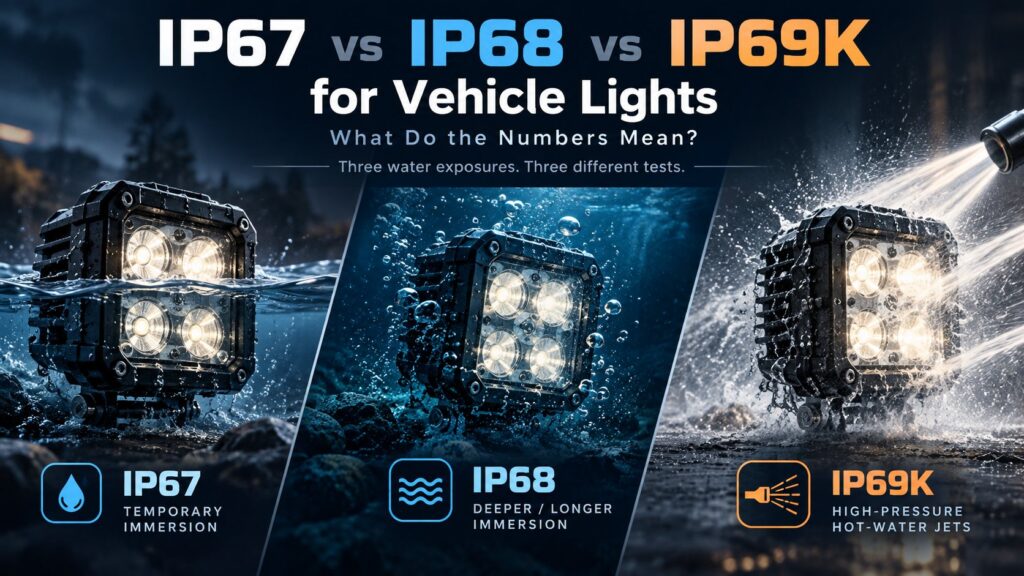
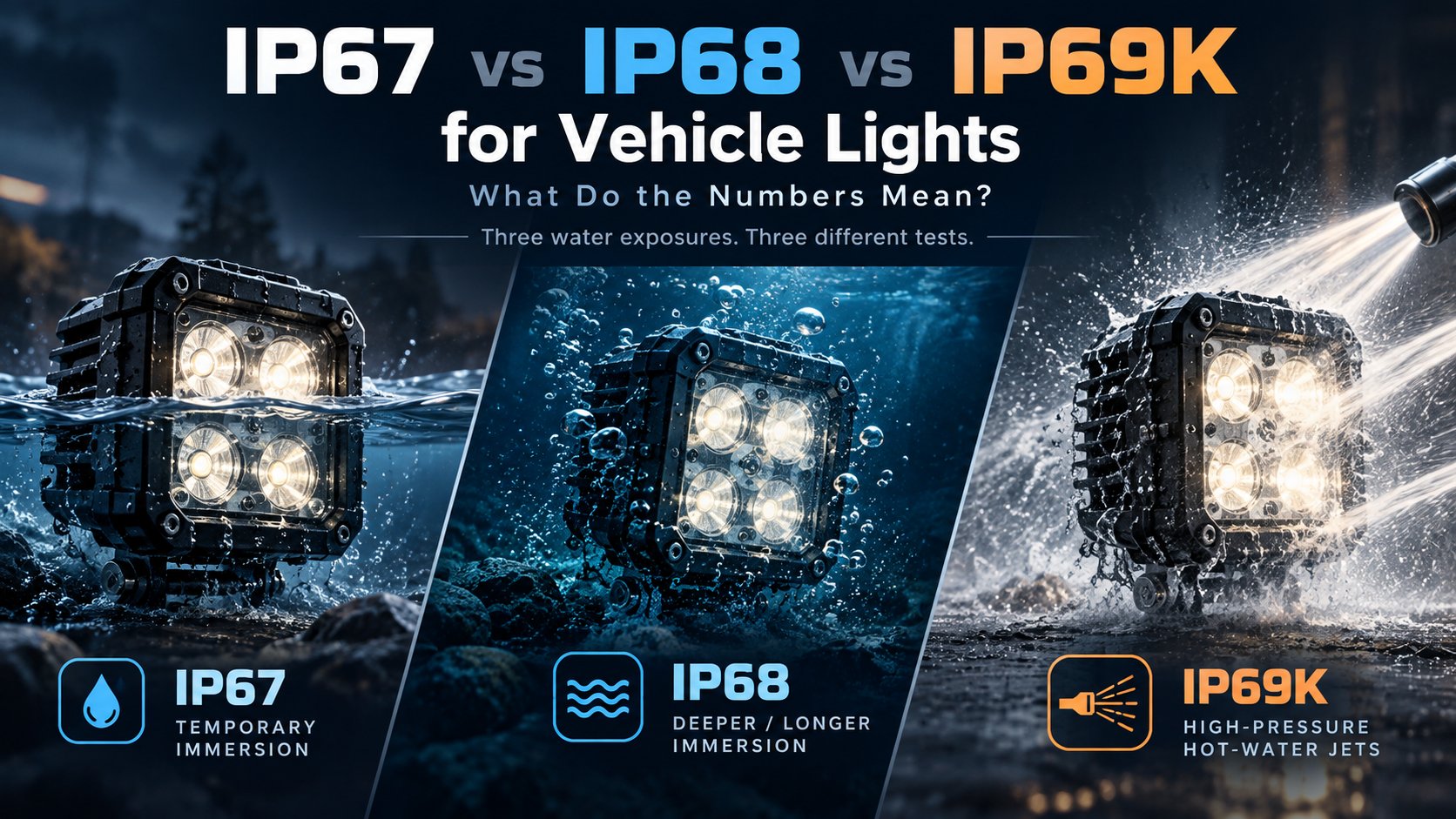
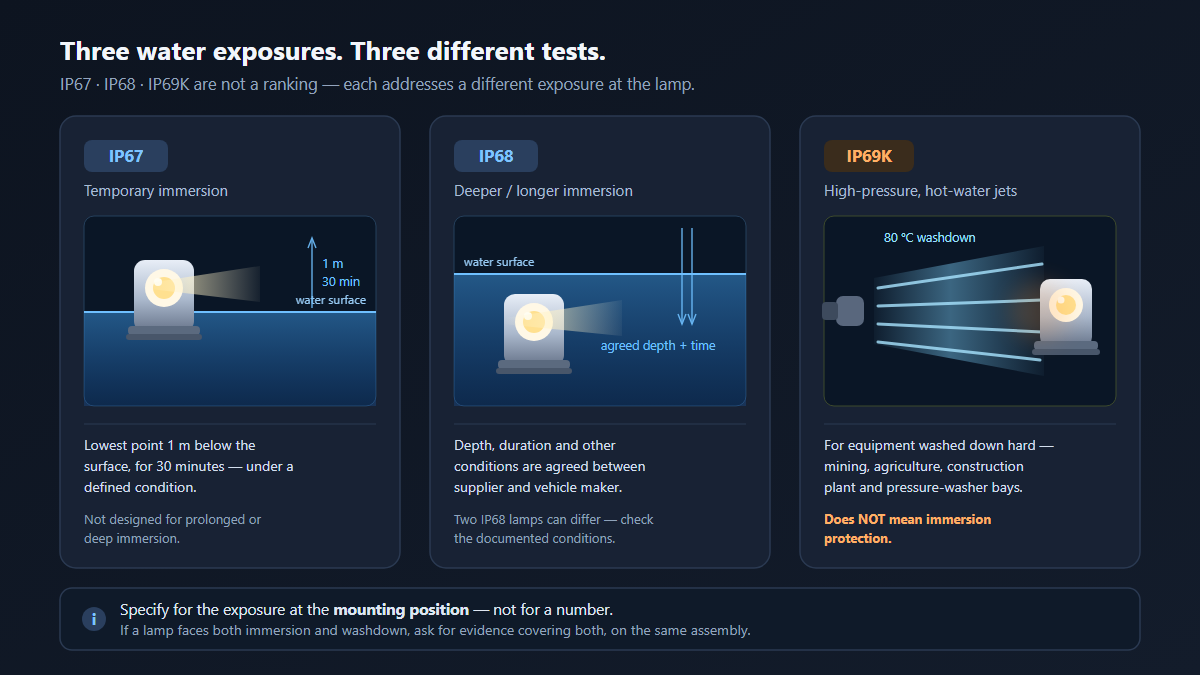
Quick answer: IP67, IP68 and IP69K are not a ranking — they test three different water exposures. IP67 covers temporary immersion. IP68 covers deeper or longer immersion agreed between supplier and vehicle manufacturer. IP69K covers high-pressure, hot-water jet cleaning. For most vehicle lights IP67 is enough for rain and temporary immersion; choose IP68 for deeper immersion, IP69K for pressure washing, and a dual rating when a lamp faces both.
What Do the Numbers in an IP Rating Mean?
An IP code has two parts, read separately. The first digit is solids protection. The second — or the letter, in codes written as 6K or 9K — is water protection. These are separate tests, so a rating can be strong on one and modest on the other.
The water part is where vehicle lighting gets confusing, because the categories were never designed as a single severity scale. IEC 60529 defines the categories. ISO 20653:2023, the road-vehicle standard, uses the 6K and 9K notation and the complete combination IP6K9K. The two standards’ notation and procedures should not be assumed identical, so a datasheet reading “IP69K” without naming a standard and edition leaves you unable to tell which procedure produced the result.
IP67 explained
IP67 addresses temporary immersion under defined test conditions.
The widely quoted description is “1 m for 30 minutes”, and that figure is real but conditional. For a lamp enclosure under 850 mm high in its working position, the IEC IPX7 test places its lowest point 1 m below the water surface for 30 minutes. That describes a controlled test for that enclosure geometry — not a universal operating depth for your vehicle (F2 Labs: what is IP testing).
What IP67 is good for: normal road vehicles, work lights and general outdoor equipment where rain, spray and occasional shallow immersion are the exposure.
What it does not promise: prolonged or deep immersion. “Temporary” is doing real work in that phrase.
IP68 explained
IP68 addresses immersion under agreed conditions more severe than water code 7.
The supplier and vehicle manufacturer agree the depth, duration and other applicable conditions — ISO 20653:2023 sets this out in Table 4. Because those conditions are agreed rather than fixed by the standard, two IP68 lamps can differ substantially in what they were actually tested for.
The word “continuous” in IP68 descriptions does not promise unlimited depth or time. To compare two IP68 lamps you need their documented conditions, not the label.
What IP68 is good for: marine equipment, low-mounted lamps on severe off-road vehicles, and construction or agricultural equipment exposed to standing water.
IP69K explained
IP69K addresses high-pressure, hot-water jet cleaning.
The IEC 60529 water code 9 and the ISO 20653 9K category cover powerful water jets directed at the enclosure. In practice IP69K is the rating for equipment that gets washed down hard — mining trucks, agricultural machinery, construction plant, and anything passing through a pressure-washer bay.
The critical point: an IP69K label on its own does not establish that a lamp meets an immersion requirement. The IEC 2019 corrigendum makes this explicit — a water-code 9 marking alone does not establish 7/8 immersion compliance, and 7/8 alone does not establish 5/6 jet compliance. If you need both exposures, ask for both tests.
IP67 vs IP68 vs IP69K at a Glance
| Rating | Protects against | Typical vehicle use | Key limitation |
|---|---|---|---|
| IP67 | Temporary immersion | Normal vehicles, work lights, general outdoor equipment | Not designed for prolonged or deep immersion |
| IP68 | Deeper or longer immersion, per agreed conditions | Marine, severe off-road, low-mounted lamps, construction and agricultural equipment | Exact depth and duration vary by agreement — check the documented conditions |
| IP69K | High-pressure, hot-water jets | Mining trucks, agricultural machinery, construction plant, pressure-washed equipment | Does not automatically mean immersion protection |
For most vehicle lights, IP67 is enough for rain and temporary immersion; choose IP68 for deeper or longer immersion, IP69K for high-pressure washing, and dual ratings when both conditions apply.
Is IP69K Better Than IP68?
No — they are not better or worse. They are different tests.
Treating them as a ranking is the most common mistake in vehicle lighting purchasing. IP69K is better at resisting a pressure washer. IP68 is better at resisting immersion. Neither substitutes for the other. If a lamp is mounted low on a truck that also gets pressure-washed, you need evidence covering both, on the same delivered lamp assembly.
One report can document both results. The point is that each requirement is covered — not that one label implies the other.
Which IP Rating Should Vehicle Lights Use?
Match the rating to the water exposure at the lamp’s mounting position, not to a fleet-wide policy.
| Application | Typical choice | Why |
|---|---|---|
| Road vehicles, general auxiliary and work lights | IP67 | Rain, road spray and occasional shallow immersion are the actual exposure |
| Off-road, overland, low-mounted lamps | IP68 | Mud, creek crossings and standing water |
| Marine and dock equipment | IP68 | Repeated immersion; confirm the agreed depth and duration |
| Mining trucks, agricultural machinery | IP69K | High-pressure washdown in the vehicle wash bay |
| Construction plant on flooded or muddy sites | IP68, or IP68 + IP69K | Immersion and washdown exposure both occur |
| Mixed fleet, washable vehicles with low mounting | Dual rating (e.g. IP68 + IP69K) | One assembly, two exposures |
Rain and an ordinary garden hose are not the same cleaning premise as hot high-pressure washdown. Record the cleaning method you actually use, and follow the product and vehicle cleaning instructions. An IP test is not blanket permission to use any washer pressure, nozzle distance or cleaning chemical — IEC 60529’s scope limits what can be inferred beyond the stated test conditions.
Why Dual Ratings Matter
A low-mounted work light on a vehicle that also enters a wash bay faces two separate requirements, for the same delivered lamp assembly.
Specify both, and require evidence covering both. Additional IP categories can be documented through multiple coding — but a single label only tells you what was tested, not what the assembly as delivered can take.
How to Read a DXZ Vehicle Light’s IP Specification
DXZ publishes an IP rating on individual product pages, stated per model rather than per range. For example, the 4.5-Inch Off-Road Spot Light Pair (SKU 45C04) is published as IP68, alongside its 9–30 V DC input, 6094 lm output and 3 m cable.
On DXZ’s own ingress-protection testing, here is the accurate position. DXZ operates an in-house testing laboratory with twelve documented test capabilities across optical, environmental, reliability and sealing evaluation — including rain testing, dust testing, UV aging, temperature and humidity, low temperature, vibration, salt spray, aging, negative pressure and air tightness tests, plus photometric and integrating-sphere measurement.
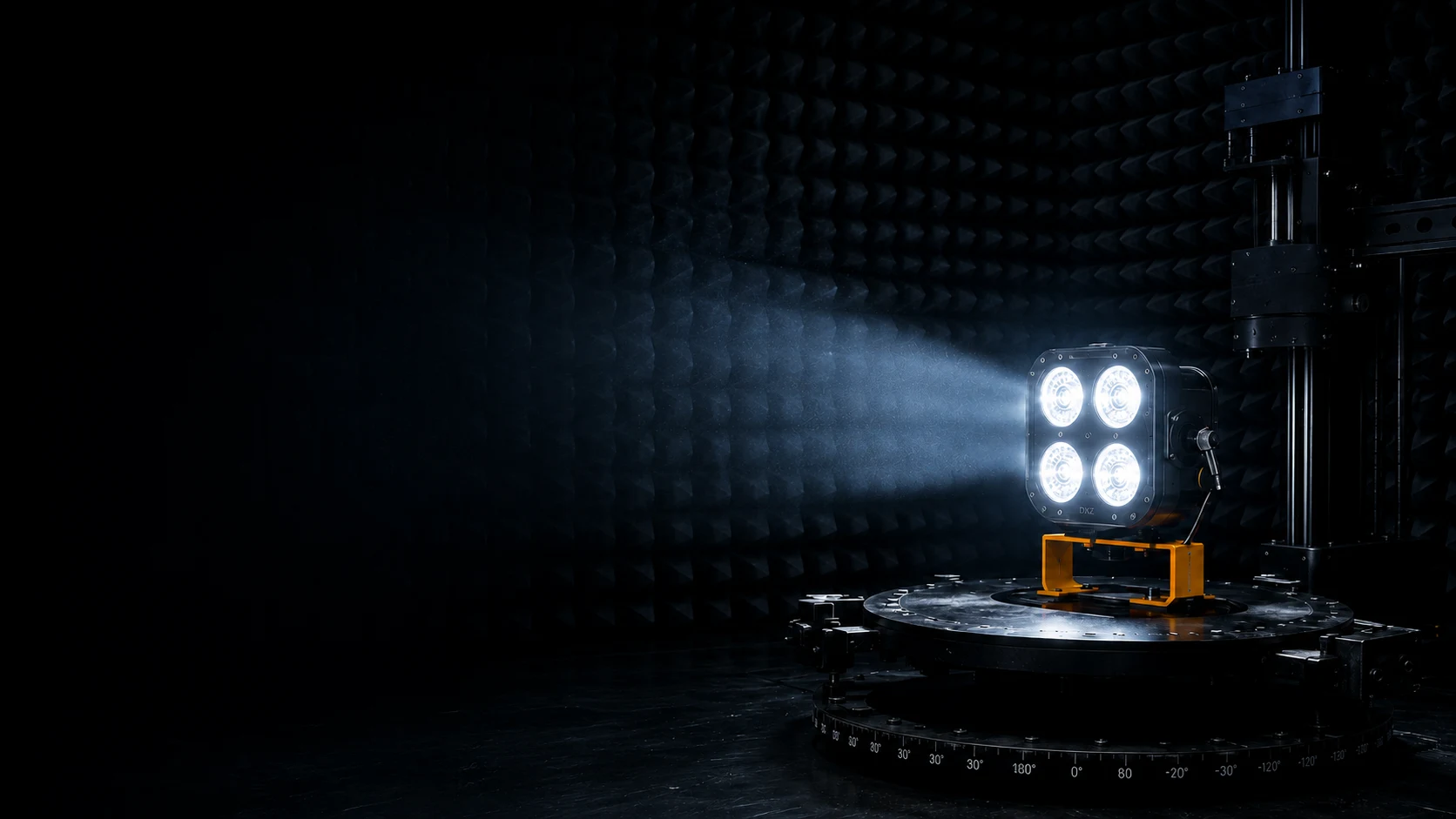
Those are real, in-house capabilities, and they are what the DXZ laboratory archive documents. They are not the same as IEC 60529 or ISO 20653 ingress-protection certification, and DXZ does not present them as such. Where a published IP rating on a DXZ product page derives from a specific test report, ask us for that report and we will state which standard, which configuration and which conditions it covers. If a report does not exist for a given model, we will say so.
We prefer that to a page that implies more testing than we document. Our photometric archive — 100 in-house GO-HD illuminance reports covering 95 model identifiers at H = 1.000 m — is published the same way, with its measurement window and its limits stated on the page. Those reports measure light distribution by angle; they are not ingress-protection data, and this page does not use them as IP evidence.
How to Specify IP Protection in an RFQ
These are editable purchasing examples, not fixed clauses prescribed by a standard.
Name the standard and the complete configuration first. State the exact lamp configuration, applicable standard and edition. Then use the wording that matches your exposure.
Temporary immersion
For the complete lamp configuration identified in this specification, confirm the temporary-immersion requirement under the stated standard and edition, including the supplied cable entry and documented connector condition.
IP68 with agreed conditions
For the complete lamp configuration identified in this specification, state the agreed IP68 immersion depth, duration and other applicable test conditions, together with the standard and edition.
Immersion plus hot high-pressure cleaning
This assembly may be immersed and is cleaned with hot high-pressure water. Provide evidence covering the required immersion test and cleaning test separately, identifying the full IP marking, tested configuration and applicable cleaning limits.
Use the last example only when both exposures apply. The evidence may sit in one report, provided it separately covers both requirements for the same configuration.
Confirm what the rating actually covers. A connector rating may depend on its mated condition. For example, Amphenol’s AT Series catalogue lists IP68/IP69K in the mated condition and directs readers to individual datasheets. A housing result and a separate component rating should not be combined into an unverified whole-lamp claim.
Before accepting a response, match: model and configuration, full marking, standard and edition, relevant conditions, and sample/result scope. Keep a manufacturer’s rating claim, a test result and a certification distinct — they answer different questions. A test pass is assessed against the applicable ingress and performance criteria; “the lamp still lights” is not the only acceptance check (TÜV Rheinland: IP testing).
An IP result also does not document separate durability, chemical-cleaning compatibility or vehicle-use requirements. For beam-pattern and electrical decisions, see the DXZ Automotive Lighting Guide.
Frequently Asked Questions
Is IP68 waterproof?
IP68 addresses immersion under conditions agreed between supplier and vehicle manufacturer — not a fixed universal depth and duration. Ask for the documented conditions. “Waterproof” without stated conditions is not a specification.
Does IP69K include IP67 or IP68?
No. IP69K covers high-pressure hot-water jets. The IEC 2019 corrigendum states that a water-code 9 marking alone does not establish 7/8 immersion compliance. If a lamp needs both, require both tests on the same assembly.
Can you pressure wash an IP67 light?
An IP67 rating does not grant permission for pressure washing. Follow the product and vehicle cleaning instructions. IP test conditions are not a general cleaning allowance, and IEC 60529’s scope limits what can be inferred beyond them.
Which IP rating is best for off-road lights?
Most off-road applications call for IP68, because the exposure is mud, standing water and creek crossings rather than rain. Choose a dual IP68 + IP69K rating if the vehicle is also pressure-washed.
Which IP rating is best for trucks and heavy equipment?
Mining trucks, agricultural machinery and construction plant are usually pressure-washed, so IP69K is the relevant category. If any of those vehicles also carry low-mounted lamps exposed to immersion, specify dual coverage.
Is a higher IP number always better?
No. The water categories are separate tests, not a single severity scale. IP69K is not “better than” IP68 — it covers a different exposure. Specify for the exposure at the mounting position.
What does IP6K9K mean?
It is the ISO 20653:2023 notation for the complete dust-tight plus high-pressure water-jet combination, equivalent in intent to the IEC 60529 IP69 marking. ISO 20653 uses 6K and 9K where IEC 60529 uses 6 and 9; the procedures are not identical, so state which standard applies.
Does the IP rating cover the connector and the cable entry?
Not automatically. A rating may apply only to the housing, or only to a connector in a stated mated condition. Confirm what the evidence covers for the complete assembly you intend to buy.
Choosing DXZ Vehicle Lights for Your Exposure
Once the exposure is defined, browse DXZ LED work lights and check each candidate’s published IP rating and configuration against it. Every model page states its own IP rating — for example the 4.5-Inch Off-Road Spot Light Pair (45C04) at IP68.
To discuss a requirement, send DXZ the lamp location, the immersion conditions and the cleaning method, together with the complete assembly you intend to purchase. If you need a specific ingress test report for a model, ask — we will confirm what exists and what it covers.